

A second brain that organizes itself
Most second brain apps ask you to build the system first: folders, tags, templates, links between notes. Reteum asks you to do one thing, put the thought in, and does the rest the way your own memory does.
Why second brains get abandoned
Personal knowledge management works when you keep it up. The trouble is the upkeep: deciding where a note goes, which tags it gets, which older notes it should link to. When capturing a thought takes a decision, fewer thoughts get captured, and the ones that do end up in an inbox nobody reviews.
How Reteum does it instead
- Take in. One box for everything: a typed line, your voice, photos, videos, links and PDFs. Widgets, the Lock Screen, Control Center and Siri catch a thought without opening the app.
- Recall. Each time you open Reteum, an older thought is waiting at the top, so what you saved comes back without a weekly review.
- Search. An AI model on your iPhone searches by meaning. Half a memory is enough: "Seattle last month", "nervous before speaking", "the lease". Photos and videos are found by what they show, and the words inside PDFs count.
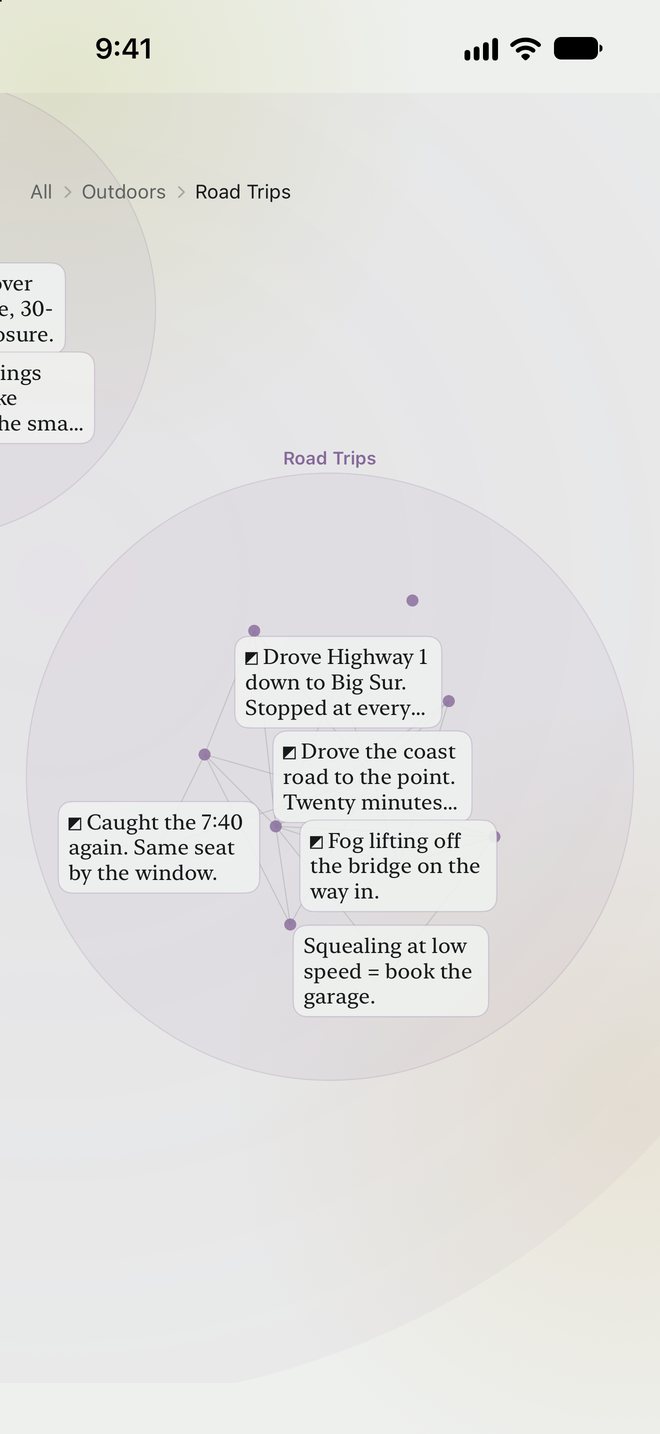
- Connect. The Atlas sorts everything into subjects on its own and links the thoughts that belong together. Open a subject and follow the lines.
A private second brain
A second brain holds the things you would not tell everyone. In Reteum both AI models run on the iPhone, even in airplane mode. There is no account and no Reteum server. If you turn on iCloud, your thoughts are end-to-end encrypted, so only your own devices can read them. You can export everything as one zip file with a Markdown copy at any time.
Is Reteum the right second brain for you?
Reteum suits people who think in fragments: a line on the way to work, a photo of a whiteboard, a voice note after a call. If you want to write long documents, build databases or work mostly on a computer, a desktop tool such as Obsidian or Notion will serve you better. Reteum is for iPhone, and it is built for catching things quickly and finding them again. How it compares with Obsidian.
See how Reteum works For iPhone with iOS 26 · 7 days free